

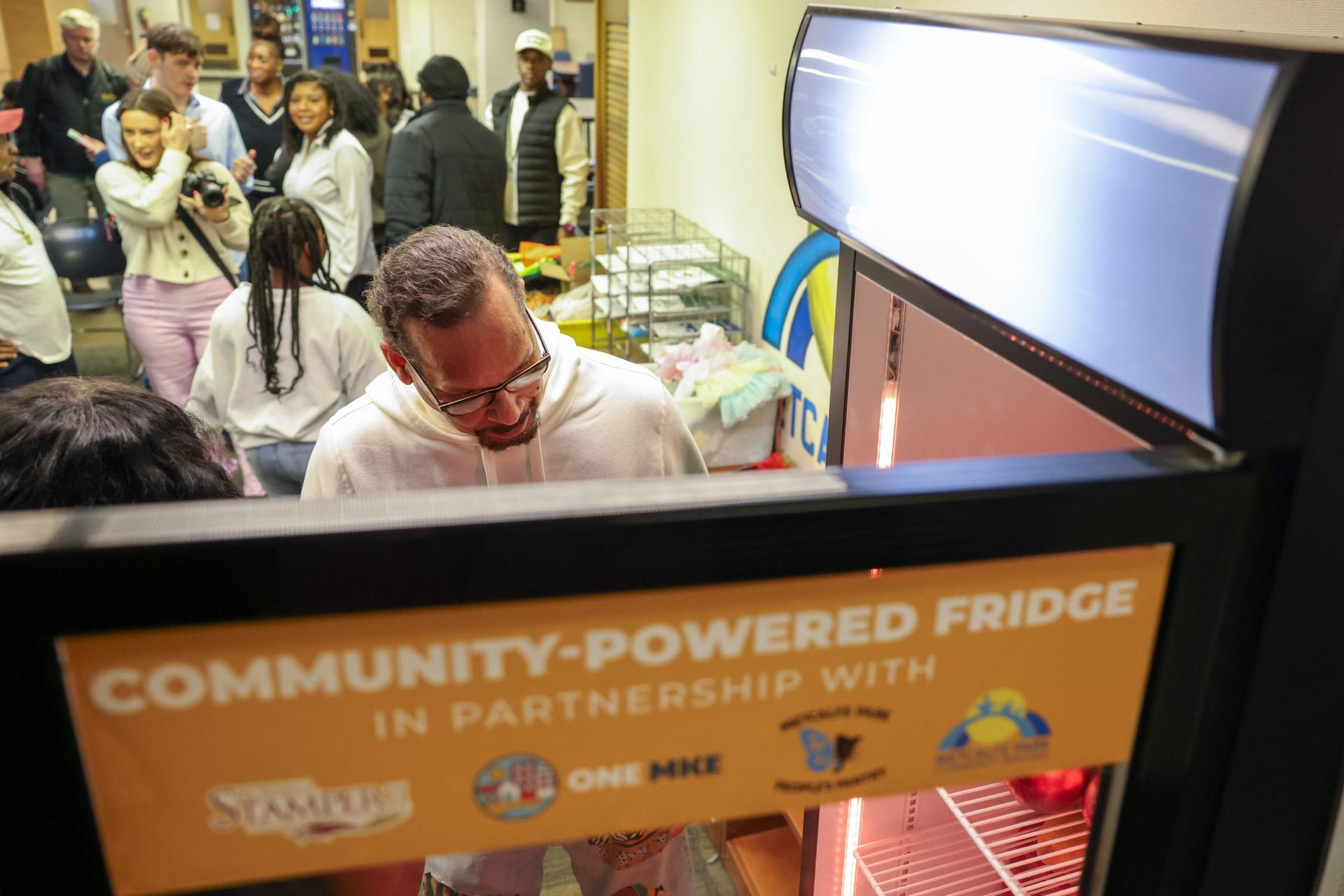


As grocery stores continue to close across Milwaukee, multiple organizations are working to keep Milwaukeeans fed.
In the last year, several Pick ‘n Saves, an Aldi and a Sentry store all closed. This followed a string of Walgreens closures and a Walmart closing. Most of the stores that closed were on the city’s North or Northwest Side.
Local grassroots organizations, including Metcalfe Park Community Bridges, the African American Roundtable and Hunger Task Force, have stepped in to ensure that Milwaukeeans have access to healthy food and are treated with dignity and respect by the food system.
Addressing a crisis
Melody McCurtis, deputy director and lead organizer of Metcalfe Park Community Bridges, a resident-led organization, said there’s more than a food desert in the city: There is food apartheid.
Metcalfe Park Community Bridges was one of the first organizations to step in to try to change that.
In July, after it was announced that the neighborhood Pick ‘n Save at 2355 N. 35th St. was closing, McCurtis and dozens of concerned residents packed into Metcalfe Park Community Bridges for an emergency town hall.

“This is deepening the crisis,” McCurtis said that day to a packed room of residents.
From there, the group hosted a march and rally to advocate for the store to stay open. When those efforts didn’t work, they regrouped.
Since then, the organization has led efforts to help people access food directly by partnering with groups like Tricklebee Cafe and FEED MKE to open community fridges and work to pass “people-first legislation” like the city ordinance that would require grocers and pharmacies to give a 90-day notice before closing.
There are currently five community-powered fridges open on the city’s North Side.
Fighting hunger for decades

Other groups, like the Hunger Task Force, have been serving for years and work to expand their reach with each threat to food access.
Since 1974, the organization has been distributing food to communities across Wisconsin, educating people about nutrition and advocating for a healthier food system.
Recently, the Task Force utilized its Mobile Market to serve communities that have lost their grocery stores.
“This is a program that’s a strategic response to the ongoing issue of food deserts and areas in our community that lack access to fresh and healthy food as well as grocery stores,” said Jonathan Hansen, chief strategy officer with Hunger Task Force.
Hansen said the market has a year-round schedule that primarily consists of senior and community centers, but the schedule changes depending on the needs of communities.
Strategic planning
The African American Roundtable is training resident leaders to develop a Northwest Side food access campaign. The campaign will work on improving equitable access to fresh, healthy and culturally relevant food.
According to Ryeshia Farmer, the organization’s community program manager, residents have specifically identified the need for more local grocery stores and farmers markets serving the Northwest Side.
Residents also want community gardens that are truly accessible and education on growing, harvesting and preparing healthy meals.
Leaders of the effort are researching what food resources already exist; exploring the logistics of farmers markets and community gardens; identifying gaps in access; and developing a strategic campaign plan.
On a systems level, both city and state representatives are working to pass bills that will change the way grocery stores operate in Milwaukee.

State Rep. Margaret Arney is advancing a bill requiring major grocery stores and pharmacies to warn communities before closing, modeled after Milwaukee’s local ordinance 251676, which requires a 90-day notice before grocery or pharmacy closures, and the federal WARN Act.
The legislation, backed by multiple co-authors, aims to align state and local policy while strengthening food infrastructure investment.
“I am going to do everything I can do at the state level,” Arney said. “But all good policy starts on the ground.”
For more information
Here is the schedule for the Mobile Market.
To get involved with Metcalfe Park Community Bridges efforts, you can follow Metcalfe Park Community Bridges or email mmccurtis@metcalfepark.org
From 9 a.m. to 4 p.m. on Saturday, April 26, the African American Roundtable is hosting a daylong retreat of campaign training.
The cohort of Northwest Side leaders will also sponsor public training sessions on organizing, recruiting people and building relationships on May 8, May 22 and June 5.
To become a Northwest Side leader, you must live in aldermanic districts 5 or 9, or in ZIP codes 53218, 53222, 53223 or 53224.
The most important thing you can do to help is vote, Arney said.
“If we want different decisions, we have to have different decision-makers,” she said.